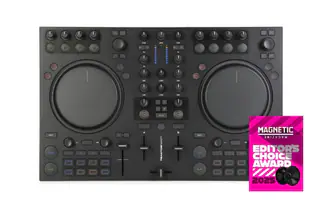
Every year, we spend an unreasonable amount of time putting new gear into real situations and seeing what actually holds up once the excitement fades and the work starts. Some products feel impressive for a few days, some look good on a spec sheet, and some quietly become part of the routine without ever asking for attention. By the end of 2025, the difference between those groups was obvious. This list brings together the pieces of gear that earned their place through daily use, long sessions, and absolute pressure, not quick demos or controlled tests. These are the tools that stayed plugged in, stayed on the desk, or remained in the bag because they solved problems and made work easier without creating new ones. Each entry below pulls the essential takeaways from a full review and reframes them in context, explaining why these products stood out over the course of the year and why they remain worth your attention going into 2026. Table of ContentsNative Instruments Traktor MX2Lunacy Taps and PortalsIK Multimedia ARC On-EarBEATSURFING LØWHEDD Audio TYPE 07 A-CORETrulli Audio Bass50AIAIAI TMA-2 Studio Wireless (Gen 2)Minimal Audio EvokeBABY Audio Smooth Operator ProIK Multimedia iLoud Micro Monitor Proécoute HeadphonesOutput Co-ProducerAlphaTheta HDJ-F10 Wireless HeadphonesMixed In Key Mixed In Key 11 ProWavebone Starship Studio Desk Native Instruments Traktor MX2 The Traktor MX2 earned its place among the best gear of 2025 because it approached entry-level DJ hardware with long-term intent, and that became clearer the longer I spent mixing on it. Native Instruments built this controller around real performance workflows, with stems, Pattern Player, and hands-on sequencing treated as core tools rather than secondary features. In practice, that meant I was reshaping tracks during transitions, layering ideas live, and staying engaged with the mix instead of managing software menus. The hardware integration with Traktor Pro felt complete, keeping my laptop in a supporting role and making longer sessions feel focused and continuous. External power paid off through stable audio headroom and clear visual feedback, especially when stacking stems or working in low-light environments. The mixer section reinforced that confidence with predictable gain staging, flexible effects routing, and Mixer FX that encouraged fast, physical decisions mid-set. The MX2 revealed itself as a controller designed to grow alongside the DJ using it, which is precisely why it took home one of our final Editor’s Choice awards of the year. Lunacy Taps and Portals Taps and Portals earned its place among the best gear of 2025 because it reframed how delay functions inside real writing and arranging sessions, and that shift became obvious almost immediately. Instead of riding feedback and hoping repeats behaved, I found myself shaping timing, spacing, and placement in a way that felt deliberate and repeatable. The multi-tap engine in Taps encouraged rhythmic thinking, while pitch control and per-tap processing kept delays harmonically anchored even as things grew dense. Portals extended that control further inside BEAM by turning feedback into a visible routing decision, which made experimentation feel intentional rather than risky. Once modulation, filtering, and gating entered the loop, movement became predictable enough to design around instead of manage defensively. Presets served as learning tools rather than endpoints, making it easy to understand why certain structures worked. IK Multimedia ARC On-Ear ARC On-Ear landed on our Best Gear of 2025 list because it solved a real headphone monitoring problem without adding friction, and that mattered more the longer I used it. By moving headphone calibration and spatial processing out of the DAW and onto dedicated hardware, it kept my monitoring consistent across sessions, devices, and locations without rebuilding chains or loading plugins. That shift changed how confidently I made low-end and center-image decisions, especially during late-night or travel sessions when speakers were not available. Hardware buttons for mono, dim, and preset switching made translation checks fast and habitual rather than something I postponed. Crossfeed and listening simulations remained subtle, which helped with panning and depth judgment without diverting attention from the mix itself. The DAC and headphone amp held up as clean, reliable tools even outside the calibration features, which extended its usefulness beyond a single role. BEATSURFING LØW LØW earned its spot among the best gear of 2025 because it tackled low-end movement as a design problem rather than a mixing fix, and that distinction showed up immediately in use. Instead of relying on static envelopes or corrective processing, it encouraged shaping bass behavior over time through hand-drawn modulation that stayed fast and intuitive. The DNA engines and seed system made it easy to generate strong starting points, while the envelope drawing and loo
IndustryAde
The Best Gear For Music Producers That Released In 2025: Magnetic Magazine’s Editor’s Choice Award
Summary of the article
Every year, we spend an unreasonable amount of time putting new gear into real situations and seeing what actually holds up once the excitement fades and the work starts. Some products feel impressive for a few days, some look good on a spec sheet, and some quietly become part of the routine without ever asking for attention.
Read the full article for more details on EDM Dance Directory News.
Share this article:
Every year, we spend an unreasonable amount of time putting new gear into real situations and seeing what actually holds up once the excitement fades and the wo...
Written and reviewed by our team. Technology may support research, but final content is human-authored.