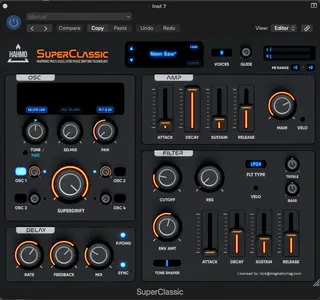
Table of ContentsBackground and Design PhilosophySound DesignPresets and First ImpressionsWorkflow and FunctionalityPerformance and CPU EfficiencyCreative Exploration Beyond TranceVisual Interface and User ExperienceFinal Thoughts On The SuperClassic There are certain sounds in electronic music that never really leave. They evolve, fade in and out of trend cycles, then return with a new sense of purpose. The supersaw is one of those sounds. It has powered trance anthems, festival main stages, and countless bedroom productions for decades. SuperClassic by Hahmo DSP steps directly into that lineage while trying to make it feel relevant again for today’s producers. At first glance, it might seem like another nostalgia-driven instrument. Spend a little time with it though, and it quickly becomes clear that this synth is not about imitation. It is about reinterpretation. SuperClassic brings the classic supersaw trance sound into the modern era at a price point that feels almost disruptive. It lowers the barrier for producers who want that high-energy sound without investing in complex or expensive tools. Background and Design Philosophy SuperClassic was designed by Joonas Hahmo, a producer whose catalog spans labels like Anjunabeats, Statement!, and Enhanced Recordings. That background matters because this is not a synth built in isolation. It comes from someone who understands what actually works in a track. The goal here feels very focused. Capture the essence of those massive layered saw sounds while stripping away unnecessary complexity. Instead of overwhelming users with endless modulation matrices or obscure parameters, SuperClassic leans into immediacy. You get results quickly, and those results sound polished. There is also a clear intent to make the instrument approachable. Whether you are a seasoned producer or just starting out, the synth meets you where you are. It does not demand a deep technical dive before you can make something usable. SuperClassic user interface Sound Design The core engine revolves around stacked oscillators that deliver the thick, detuned character associated with classic trance. And let’s talk about the sonic applications this thing provides the user. Texturally, the range is broader than expected. You can dial in gritty acid lines that cut through a mix, build lush and soaring pads that fill out space, or push things into chaotic territory with aggressive leads and arpeggios. The synth responds well to both subtle shaping and more extreme experimentation. The filters play a huge role in defining the sound. I really appreciated how they are so responsive when both using a MIDI controller and in mapping automation, making it easy to carve out movement without losing the core character. This becomes especially important when layering multiple instances, since each layer can occupy its own space without becoming muddy. The thing that really got me excited about this plugin is the SuperDrift knob. Each of the 4 oscillators has independently assignable values for Tuning, Panning, Amplitude, and SuperDrift. Instead of just a standard detune, SuperDrift provides you with micro-adjustments that make the sound feel wider, more natural, and even give it more of that subtle chaos of analog synths. Logic Pro Session w/SuperClassic from Hahmo DSP Presets and First Impressions The preset library is an excellent starting point. It showcases the expected supersaw leads and pads, but it also hints at the broader capabilities of the synth. What stands out is how usable these presets are in a real production context. They do not feel overprocessed or overly specific. Instead, they act as solid foundations that can be tweaked and adapted quickly. For new users, this makes onboarding almost effortless. I was able to get inspiration from just loading up a few of the presets, making minor adjustments, and immediately hear how the synth responded. This definitely made me want to keep composing for hours. Workflow and Functionality One of the strongest aspects of SuperClassic is how intuitive it feels. The GUI is very user friendly and clicks almost instantly. There is no steep learning curve or hidden complexity. Everything is laid out in a way that makes sense. Oscillators, filters, envelopes, and effects are all accessible without digging through menus. This keeps the creative flow intact, which is often where other synths fall short. Automation is another highlight. The parameters respond smoothly, making it easy to create evolving sounds. This becomes particularly powerful when working with filter sweeps and effect modulation. Small changes can lead to significant shifts in tone and energy. AMP & FILTER sections Performance and CPU Efficiency This is an area where SuperClassic quietly excels. It is very easy on CPU usage, which has a direct impact on workflow. You can stack multiple instances without worrying about performance issues. This opens up creative possibilities that might otherwise be
IndustryTranceElectronic
SuperClassic Review: Powerful Modern Take on Timeless Supersaw Sound
·
Summary of the article
Table of ContentsBackground and Design PhilosophySound DesignPresets and First ImpressionsWorkflow and FunctionalityPerformance and CPU EfficiencyCreative Exploration Beyond TranceVisual Interface and User ExperienceFinal Thoughts On The SuperClassic There are certain sounds in electronic music that never really leave. They evolve, fade in and out of trend cycles, then return with a new sense of purpose.
Read the full article for more details on EDM Dance Directory News.
Share this article:
There are certain sounds in electronic music that never really leave. They evolve, fade in and out of trend cycles, then return with a new sense of purpose. The...
Written and reviewed by our team. Technology may support research, but final content is human-authored.