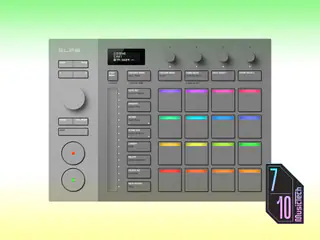
£259 / $299 / €277.70, serato.com A name once associated primarily with DJs, Serato has been quietly building its reputation in the production world. It launched Studio, its unique DAW, in 2019, but it’s only now that the software has received dedicated hardware, created in collaboration with DJ equipment titan — and parent company — AlphaTheta. READ MORE: I swapped Ableton Live for Renoise 3.5 — here’s what I learned SLAB is a compact pad-based controller designed to escape the tedium of the mouse and keyboard, offering tight integration with Serato Studio for hands-on beatmaking. With its easy-to-grasp approach, SLAB is well poised to help first-timers make the intimidating jump from decks to DAW — but its simplicity cuts both ways. I check out a test unit to find out whether SLAB is the bedrock for budding producers, or merely a stepping stone that you’ll soon outgrow. Image: Press Is Serato SLAB well built? Straight away, Serato gets kudos for SLAB’s design, its minimalist aesthetic finished in a stony grey that contrasts beautifully with its pastel-hued backlights. Its controls feel premium, particularly for a device costing $299. SLAB’s pads are effortlessly playable, and its touch strip is responsive, while soft-touch clicky buttons provide just enough haptic feedback to know they’ve done their job. I’m using a 13-inch MacBook — SLAB is a little smaller but twice as thick. Serious points for portability, considering it only weighs 1kg. Nonetheless, the unit feels solid on the desk and doesn’t move around, even when you’re frenetically freestyling like Fred Again. SLAB’s face is slightly tilted as well, a subtle touch that makes the device feel remarkably ergonomic to use while sitting. I’m caught off guard by how perfectly everything seems to have been considered from a physical standpoint. Image: Press Programming drums with SLAB To begin, I configure the large left-hand dial to Library mode and rifle through various drum kits and instruments, although my own samples and Serato DJ library are also accessible. It feels much like selecting tracks on a CDJ system, which isn’t surprising given AlphaTheta’s pedigree. Once I’ve loaded a kit, I use the Auto-Set button to instantly populate the sequencer with a new drum part based on a selected genre. The patterns are fairly unremarkable, but they do provide a quick way to get going. I throw out the preprogrammed beat and punch in something vaguely Kaytranada-esque with swing. The combination of live recording and SLAB’s 16th-note step sequencer mode feels fluid, and it doesn’t take long to build up a dense drum arrangement — and I’m yet to lay a finger on the mouse or keyboard. I’m curious to see how SLAB handles the more intricate details. It’s relatively easy to adjust micro timing with the dial for a more human feel, but I trip a couple of times with note velocities. These can be quickly changed using the touch strip, but the strip’s lighting doesn’t immediately reflect a note’s velocity on selection, so I’m left guessing at its current value. And, once I extend the loop beyond four beats, keeping track of which bar I’m editing demands some back-and-forth between SLAB and the laptop. An indicator on the device screen would work wonders. Maybe Serato can address these quirks in a future firmware update. Image: Press Developing a loop with SLAB With my percussion in place, I flick through the browser once more, auditioning longer samples that I can chop up, MPC-style. The Auto-Set button makes this incredibly swift, intelligently placing slice markers that are automatically mapped to the drum pads. Selected slices can be locked down with the Favourite button, while the remainder are refreshed with new options on the next Auto-Set command. It’s a lightly addictive gamble, and I get caught in ‘just one more’ mode at the prospect of discovering a magical snippet of audio on my next roll of the dice. I add a bass sound to a new Deck, the pads conveniently mapped to a scale that matches my previous key. Clearly, Serato has done its best to eliminate menial tasks from beatmaking, and the result is an incredibly immediate process where everything ‘just works’. This simplicity does come with trade-offs. The instruments in Studio have relatively few parameters to adjust, and while that might suit beginners, it fast becomes frustrating for more advanced sound design. Studio’s quantisation also leaves me wanting. It only applies to note start, not note end, and there’s no manual quantisation option after recording. I find no way to change note length within SLAB’s step sequencer mode either, and have to swap to the laptop to finish the job. Remixing with SLAB SLAB’s workflow has been rock-solid so far, but nothing extraordinary. That all changes with Studio’s genuinely impressive stem separation. I load a full stereo bounce from my music library and use SLAB’s four parameter knobs to isolate the vocals — in real time and with remarkable clarity — as if I’m mixing a
IndustryAdeFred Again
SLAB is an ambitious leap into Serato Studio hardware — and it deftly sticks the landing
·
Summary of the article
Serato’s slick new controller delivers an immediate, hands-on workflow, but sometimes feels restrained by its software sibling The post SLAB is an ambitious leap into Serato Studio hardware — and it deftly sticks the landing appeared first on MusicTech.
Read the full article for more details on EDM Dance Directory News.
Share this article:
Serato’s slick new controller delivers an immediate, hands-on workflow, but sometimes feels restrained by its software sibling The post SLAB is an ambitious lea...
Written and reviewed by our team. Technology may support research, but final content is human-authored.