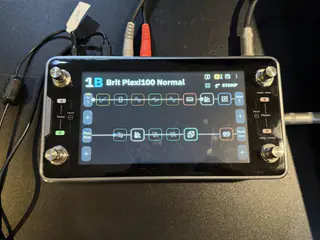
Everything At A GlanceSome background contextThe technical stuffSmall size, big soundReal-world usageFinal verdict on the Neural DSP Quad Cortex Mini At NAMM 2026, Neural DSP unveiled the Quad Cortex mini, a condensed version of their highly praised Quad Cortex. While less than 50% of the original’s size, the mini features the same internal computing power, a new 7” touch screen, and other smaller changes. In this review, we’ll be taking a look at the little powerhouse and how it fits into an electronic music producer’s workflow. Some background context I’ve been making music for 15 years now, and playing guitar for 23 (which doesn’t feel right to write), and have owned a variety of guitar and amp setups. Although my focus shifted from guitar to electronic music, and despite selling my half stack, playing guitar has always been something I’ve held on to. Nearly 6 years ago, I bought an Axe FX 2 XL to restart my guitar journey. As great a machine as it is, the workflow is clunky, and the tones feel very dated. I mention this because when I was given a demo of Quad Cortex mini, it felt extremely refreshing and modern. Simple workflows, intuitive controls, and instant results stood out most. During the demo, I was surprised by the quality of the effects, as previous experiences with the Axe FX sounded a bit cheap and flat. After expressing my surprise, the representative mentioned that their designer actually came from a large company specializing in analog synths and top-notch software. Makes sense. The rep then mentioned he occasionally used it as an FX channel strip. That got me thinking about how something like this could fit into a modern techno producer’s workflow. What if I used this as an external effect and sent all my gear to it? Spoiler: it’s sick. The technical stuff Inputs Input 1: 1/4″ TS instrument. Input 2 / Capture Input: combo XLR + 1/4″ TRS, dedicated level control, phantom power (mic or instrument), also used for captures. Outputs 2x balanced XLR outs (Outs 1/2). 2x 1/4″ TS outs (Outs 3/4). Headphone out: 1/8″ TRS. FX loops “Dual effects loops” but implemented with shared TRS send and TRS return. TS cable = Loop 1 only. To access both loops, you need TRS insert cables (TRS to dual TS). USB Works as a USB Audio class-compliant interface via USB-C, 24-bit / 48 kHz, 8 in/out. MIDI + expression MIDI in/out/thru on 1/8″ TRS Type-A, plus MIDI over USB. Expression: one 1/4″ TRS expression input, second expression available via MIDI. Power 12V DC, 1.2A, center-negative, locking 2.1/5.5mm connector; PSU included, plus non-locking adapter for standard pedalboard supplies. WIFI Connectivity Built-in Wi-Fi and Cortex Cloud integration; download content, update firmware, and manage wirelessly. Presets/backups move between QC mini and full QC. Small size, big sound As mentioned, Neural went with the “less is more” approach on the mini. Many times, when a company creates a smaller version of a flagship model, you tend to get a lot of compromises. While the mini has 7 fewer footswitches, Neural has compensated by turning the 4 it does have into multi-use ones. The same goes for the ins/outs. The mini features combined send and return ports, swaps full-sized MIDI ports for 3.5m jacks, loses one of the expression outputs, but gains USB-C, and changes input 1 from a combo input to solely a 1/4” port. Otherwise, the mini is exactly the same. The minor changes have brought greater portability, perfect for those with compact spaces or live rig setups. The dual outputs and routing options allow you to run two separate signal paths, giving you the flexibility to use the mini as a single unit for both your guitar and mic or other source. One of the company’s defining features is Neural Capture. This is essentially how the company became the giant it is today. The Cortex has this on board, which makes this unit different from a typical modeler. In short, it can capture all of your amps, cabs, and also gain-staging pieces like drive pedals and compressors, allowing you to take a snapshot of your full rig setup at home, and any variations of it, but only have to take the Cortex to your gigs. If you thought carrying records to a gig was a pain, it pales in comparison to moving full amp stacks and drum kits around just to practice at your friend’s house or actual gigs. Hurts my back to even think about those days… There are two different versions. Capture V1 runs on-device and offline. V2 is processed through Cortex Cloud and is aimed at more touch-sensitive, dynamic sources, which Neural DSP specifically highlights improved realism for things like fuzz, compressors, and dynamic tube amps, including behaviors such as volume cleanup and transient response. Real-world usage My current setup consists of two guitars, a bass, a few synthesizers, and a drum machine. One of my synths already has a delay and chorus, but it sounds incredible when I add reverb to it. Trying all the different effects on the Cortex was extremely ea
IndustryTechnoHouse
Neural DSP Quad Cortex Mini Review: Neural DSP Quad Cortex mini amp modeler
Summary of the article
Everything At A GlanceSome background contextThe technical stuffSmall size, big soundReal-world usageFinal verdict on the Neural DSP Quad Cortex Mini At NAMM 2026, Neural DSP unveiled the Quad Cortex mini, a condensed version of their highly praised Quad Cortex. While less than 50% of the original’s size, the mini features the same internal computing power, a new 7” touch screen, and other smaller changes.
Read the full article for more details on EDM Dance Directory News.
Share this article:
At NAMM 2026, Neural DSP unveiled the Quad Cortex mini, a condensed version of their highly praised Quad Cortex. While less than 50% of the original’s size, the...
Mentioned In This Article
Cities
Written and reviewed by our team. Technology may support research, but final content is human-authored.