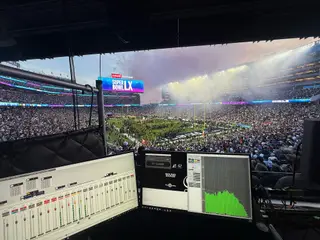
Over 120 million people tuned in to watch Bad Bunny honour Latin America with his Super Bowl halftime performance. But for the 68,500 people lucky enough to see the show live at California’s Levi’s Stadium, Johnny Keirle was there to ensure the audio honoured the moment. Keirle is a freelance audio system engineer who has run sound for everyone from Adele to Rüfüs Du Sol. When he dials into our video call, he’s taking a quick break during prep for Rosalía’s LUX world tour. READ MORE: “You could work for 10 years on a Sphere show if you wanted to”: Inside the creation of Illenium’s odyssey 2026 was Keirle’s fourth Super Bowl, and until he came on board, the NFL placed the bulk of its audio emphasis on the broadcast. He sought to change that. “Since I’ve come in, I’ve fought really hard to step things up—to have a proper audio concert experience, rather than just having sound reinforcement out on the field,” Keirle says. Keirle designs the temporary PA system for the halftime show. That includes choosing the exact speaker specifications that will provide complete sound coverage for the in-house audience. He also communicates with the National Football League (NFL) and ATK, the Super Bowl’s in-stadium audio provider for over 30 years, on how best to operate the sound in the wake of the massive, intricate production. This year, because Levi’s Stadium is open-air, Keirle had the speakers on carts rather than flying the speakers from the ceiling. This opened more lines of communication to other personnel, such as groundskeepers who maintain the field, and team managers who are responsible for everyone on the sidelines during the game. Image: Johnny Keirle “There are a lot of things I have to approach differently to put the TV side first, which is strange,” Keirle admits. “I have to make compromises in terms of where I can position things and what sort of weight capacities I can have.” These restrictions make it essential for Keirle to build a virtual mockup of the sound system long before any live implementation. That way, he can send proposed technical breakdowns to the NFL, ATK, and any other parties involved and make changes based on their notes with a few clicks instead of having to move carts and put down new placement markers on the field. “The vast majority of my design and advanced work is in this prediction software,” Keirle says. The software in question is Soundvision, by French audio manufacturer L-Acoustics. With this program, Keirle can use the precise specifications of the stadium, sound rig, and placements to simulate how the audio will cover the actual performance. “I’m so familiar with it. I’ve been using it for so many years that I’m very confident and comfortable with the interpretation of the data it gives me,” Keirle says. Having that confidence can ease the minds of the higher-ups overseeing the billion-dollar operation. “It was quite a bit of uncertainty for everybody involved going back from a flown system to a ground-based system. Because I was able to show them in the mapping software the performance capabilities relative to what we’d had in the previous years, it offered them comfort as well,” Keirle says. “That’s a consideration too: Make sure that the people paying for everything have confidence in what you’re putting in.” Image: Johnny Keirle Keirle also uses L-Acoustics loudspeakers for the event, which are easily compatible with Soundvision. In total, there are 18 carts positioned around the field, which is broken up into four quadrants. Each cart has two KS28 subwoofers, two K1-SB subwoofers, and either four or five K2 line arrays. Some carts also have A15 wides as fills. “Each [cart] had slightly different configurations in terms of how they were deployed. So, obviously, every cart has to go in a specific place. There can’t be any jumbling,” Keirle says. He’s been using these speakers since he came on to the Super Bowl in 2022, so when they switched over to carts, they built them specifically to hold these components. “The carts were modified for these loudspeakers. The K1SB subwoofers mechanically pin into the cart, which makes it a lot more stable to move. I chose the K2 loudspeakers because of the flexibility they offer in terms of vertical coverage and horizontal coverage. I can steer and project the sound energy with a lot of flexibility compared to some other loudspeaker options.” Once the audio layout was approved by the NFL and all the other parties, everything came down to making the show happen in such a short amount of time. Keirle was supervising over 100 people specifically for the carts: five local crew per cart, members of the ATK team, and his own trusted engineers looking after each quadrant. They needed to move them on the exact pre-planned route, ensure the placements are correct, and be available to handle any troubleshooting in the moment. However, despite the tremendous amount of effort in the minutes during setup and teardown, the huge amount of rehearsal
IndustryHouseAde
Johnny Keirle on amplifying the Super Bowl halftime show: “I’ve fought really hard to create a proper audio concert experience”
·
Summary of the article
The seasoned audio touring engineer has designed the in-house sound system for the last four Super Bowls The post Johnny Keirle on amplifying the Super Bowl halftime show: “I’ve fought really hard to create a proper audio concert experience” appeared first on MusicTech.
Read the full article for more details on EDM Dance Directory News.
Share this article:
The seasoned audio touring engineer has designed the in-house sound system for the last four Super Bowls The post Johnny Keirle on amplifying the Super Bowl hal...
Written and reviewed by our team. Technology may support research, but final content is human-authored.