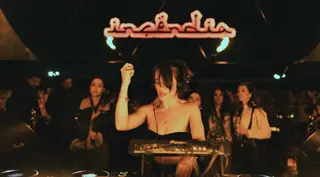
Regina Picone has been steadily carving her space within the global progressive circuit, and 2026 marks a defining step forward. The Córdoba-born DJ and producer recently co-founded All Life Records alongside Luciano Cariddi, a new imprint focused on forward-thinking progressive music and a clear artistic identity. Its second release, her own single “Plastic Heart,” lands on March 6 and represents her first release on a platform she now helps shape from the inside. Snag The Track (On Pre-Order Until March 6th) Here With early support from Hernán Cattáneo, a debut performance at Amsterdam Dance Event in 2025, and a European tour on the horizon, Regina’s trajectory continues to expand beyond South America. In this conversation, she reflects on intention, longevity, and the evolution of her taste, breaking down how her crate mirrors her growth and why “Plastic Heart” feels like a natural extension of the voice she has been refining for years. Interview With Regina Picone When someone hears one of your sets, what do you hope they learn about your taste? I hope they understand that my taste is intentional. Nothing is there by accident. The transitions, the pacing, the harmonic choices, they’re all part of a larger narrative. I’m drawn to music that holds tension and moves with purpose, not just impact. And if, by the end of the journey, they feel more alive than when they started, then I’ve done what I came to do Do you think your crate reflects who you actually are—or is it more who you want to be seen as? I think over time the two become the same. At the beginning, maybe there’s a difference between who you are and who you want to project. But eventually, if you stay consistent, your crate becomes a reflection of your real taste. There’s no need to perform an identity, the music speaks for you. Every gig requires a different language, but the voice behind it is always the same How do you know when a track really belongs in your rotation versus being a passing phase? I don’t decide immediately. If a track still makes sense after a few weeks in different contexts, at different times of day then it probably belongs. If it only works in one specific moment, it’s usually a phase. For me, longevity is the filter. A record has to hold tension without relying on novelty. If I can return to it and still find depth in the groove, then it earns its place in the rotation. Has your crate ever surprised you—like, “I didn’t realize I was into this sound right now”? Occasionally. But it’s never a jump, it’s a transition. When I notice a change in my crate, it usually means I’ve been refining something quietly. The direction was already there. I just hadn’t labeled it yet Do you keep folders or playlists that are just for you, even if you rarely play them out? Yes. Not everything I collect is meant for the dancefloor. Some tracks are just references, ideas about texture, arrangement, or mood. They might never be played out, but they shape how I think about sound. Those folders are more personal. They’re less about reaction and more about reflection What’s a sound, mood, or genre you’ve always felt drawn to—regardless of whether it’s trendy? I’ve consistently felt drawn to hypnotic techno and dark disco textures. There’s something about repetition and controlled tension that feels honest to me. Trends change, but that sense of immersion has always stayed What do you think your taste says about your story as an artist? I think your taste tells the story of your patience It shows how long you’ve been willing to listen, to refine, to let things evolve instead of forcing them. In my case, it reflects a preference for depth over immediacy, for structure over excess The post Inside Regina Picone’s Intentional Sound and the Story Behind “Plastic Heart” appeared first on Magnetic Magazine.
IndustryTechnoAmsterdam Dance Event
Inside Regina Picone’s Intentional Sound and the Story Behind “Plastic Heart”
·
Summary of the article
Regina Picone has been steadily carving her space within the global progressive circuit, and 2026 marks a defining step forward. The Córdoba-born DJ and producer recently co-founded All Life Records alongside Luciano Cariddi, a new imprint focused on forward-thinking progressive music and a clear artistic identity.
Read the full article for more details on EDM Dance Directory News.
Share this article:
Regina Picone has been steadily carving her space within the global progressive circuit, and 2026 marks a defining step forward. The Córdoba-born DJ and produce...
Mentioned In This Article
Cities
Written and reviewed by our team. Technology may support research, but final content is human-authored.