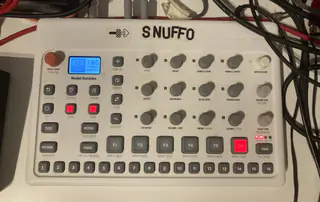
Benedikt Schmidt loves the diverse forms of artistic expression. He sees art as a vital necessity. For him, art is not only a form of escapism, but it also carries the wonderful promise of making the world a better place. In creative ways, it can spark social developments, criticize conditions, enable resistance, and bring about positive change, both for the moment and in the long run. Whether music, literature, theater, film, painting, photography, sculpture, performance art, or dance – the arts, especially those that go beyond mere entertainment and superficial consumption, touch us emotionally as well as intellectually. They open our eyes. They liberate, inspire, encourage, comfort, irritate, and unsettle. And they can pose existential questions and provide surprising answers. These convictions became the starting point for Benedikt Schmidt’s new album as Snuffo. Its title is more than just a name – it is meant as a call to action: Embrace The Arts As an artist, Schmidt himself works across disciplines. In addition to producing and performing as Snuffo and Snuff Crew, he writes novels, poetry, and radio plays. Under the alias Cellarkalt, the German guy also stages experimental performances and video installations. With decades of experience, he knows all too well: creativity cannot be forced. It must come from within. Only then does something of substance and impact emerge. That‘s also why imagination plays a central role for Benedikt Schmidt. It is the origin, tool, and driving force at once. After reflecting on the arts, he began to imagine what the new Snuffo long-player should sound like. Soon, a feeling was there. A vague inner image that gradually took shape. But only when he truly felt ready did Schmidt carefully begin to unearth it and translate it into music. Elektron Model:Samples The Model:Samples from Elektron is a sample-based groovebox. It features six tracks per pattern and a powerful 64-step sequencer. You get lush built-in effects like wild delay, deep reverb, an LFO, and a filter. Thanks to its punchy volume and gritty distortion, this machine delivers a fat, energetic sound. Plus, it’s super easy to use, lightweight, and totally affordable. Alongside the digital drum synth LXR-02 (by Erica Synths and Sonic Potions), the Model:Samples is the heart of my studio sessions and live performances. It doesn’t just drive the rhythms and give the drums and snares their signature swing; I also load basses, stabs, and other samples across its six tracks. On the album, you can hear it in action on “Escapist”, where it lays down the beat and those dubby chords. In the electro tracks “Late Night Thoughts” and “Dissent”, it takes care of the basslines, too. What I love most about the Model:Samples is its incredible ease of use. I usually start by building a pattern and then record it live, combining it with other synths and devices. I don’t spend days hunting for the perfect sound or weeks tweaking arrangements — I rely on intuition and a more spontaneous workflow. For that, I need gear that’s simple, hands-on, and lets me stay in the creative flow. I’m not great at teaching others, and I don’t really have any secret tricks. Since I rarely read manuals all the way through or binge-watch tutorials, my process is pure learning by doing. (Making mistakes can be truly rewarding!) I honestly believe everyone should take the time to find the gear and workflow that truly fit them. After producing music for many years in a DAW (mostly in Reason), I switched to hardware about five years ago. I wanted a fresh start. And by then, the right and affordable machines for me had finally hit the market. At first, I experimented with the Tracker by Polyend, then played around with an Electribe Sampler. But it wasn’t until I got my hands on the Model:Samples that everything clicked. It just felt right, and it’s been my trusted companion ever since, both on the road and in the studio. Bastl Instruments Kastle 2 Wave Bard I have to mention this tiny powerhouse. It’s an experimental sample player that lets you upload your sounds through an online platform where you can build your own custom sample banks. It offers 89 seconds of mono or 44 seconds of stereo sample time. The Wave Bard is patchable (mini patching cables!), which opens up wild possibilities for sound mangling and creative modulation. On top of that, it comes with either a delay or phaser effect. Playing around with the Wave Bard was the starting point for my album. The first tracks that came out of it (sometimes with subtle support from Arturia’s MicroFreak) were “Rituals,” “Whims,” and “Pursuit of Happiness.” The unpredictability and raw sonic character of the device completely blew me away. For a moment, I even considered making the entire album using nothing but the Wave Bard, and without a single 4/4 beat. In the final track of “Embrace The Arts”, the melancholic electro cut “Balm”, a few tones from this sound machine flutter through the mix, giving the pi
Summary of the article
Benedikt Schmidt loves the diverse forms of artistic expression. He sees art as a vital necessity. For him, art is not only a form of escapism, but it also carries the wonderful promise of making the world a better place. In creative ways, it can spark social developments, criticize conditions, enab Read the full article for more details on this EDM news story.
Read the full article for more details on EDM Dance Directory News.
Share this article:
Benedikt Schmidt loves the diverse forms of artistic expression. He sees art as a vital necessity. For him, art is not only a form of escapism, but it also carr...
Written and reviewed by our team. Technology may support research, but final content is human-authored.