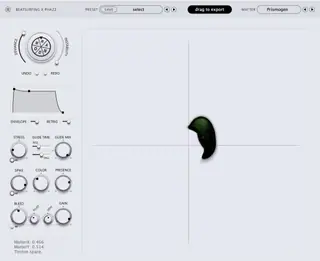
Morkhal has continued to refine a focused production approach built around tension, rhythm, and long-form development. His new EP Aether Construct, released via his own 3MOON Records on January 30, 2026, captures that direction across four tracks designed for extended club environments. The project reflects a clear studio mindset where movement and pressure are shaped gradually rather than through constant variation, with each track functioning as part of a single system. For this How It Was Made feature, Morkhal broke down the core tools that defined the EP’s internal motion and structure. Instead of outlining a full session walkthrough, he selected the plugins that carried the most responsibility across the record, explaining how each one was applied, controlled, and restrained to maintain cohesion. The focus stays on function and placement, showing how modulation, texture, and bus processing were used to support repetition without flattening energy. The How It Was Made feature below is presented directly from the artist and organized by tool. For producers working in dark or hypnotic techno, this breakdown offers a clear reference for building controlled evolution inside a track while keeping systems efficient and intentional. RANDOM by Beatsurfing RANDOM is a modulation-focused plugin designed to introduce controlled unpredictability into your sounds. Rather than generating audio itself, it works by modulating parameters in real time using randomised values that can be synced, smoothed, or locked to specific ranges. This makes it incredibly useful for adding movement, variation, and life to otherwise static elements. It’s simple on the surface but extremely powerful once you start routing it creatively. In this track, I used RANDOM to subtly modulate parameters on synth layers and effects rather than driving anything too aggressively. I mapped it to filter cutoff and wavetable position, keeping the depth low so the movement stayed organic and hypnotic. Slow rate settings were key, allowing the sound to evolve over time without breaking the groove. In some sections, I automated the modulation amount to increase tension during transitions, then pulled it back once the drop hit, keeping everything feeling alive but controlled. For dark or hypnotic techno, RANDOM is best used with restraint — tiny changes over long periods have far more impact than obvious modulation. One trick I’ve learned is to map it to just one or two parameters and let it run in the background, almost unnoticed. It’s especially effective on pads, textures, and effects returns where movement adds depth without stealing focus. Think of RANDOM as a way to humanise machines and keep repetition feeling intentional rather than static. Ableton Wavetable Wavetable is Ableton Live’s stock wavetable synthesiser, designed for modern sound design with a clean, intuitive layout. It allows you to morph smoothly between different waveforms, making it ideal for evolving basses, pads, and textured leads. The synth includes two main oscillators, a flexible modulation matrix, and built-in filters and effects that are well suited to electronic music. Despite being a stock plugin, it’s extremely powerful and capable of very deep sound shaping. In the track, I used Wavetable to create an evolving mid-layer that sits between the bass and the atmosphere. I started from a basic wavetable preset and manually adjusted the wavetable position, automating it slowly over time to create movement without distraction. Subtle filter automation helped control energy across different sections, while light saturation and Ableton’s stock reverb were used to add warmth and space. I kept the sound intentionally restrained so it enhanced the groove rather than dominating it. For producers working in darker or hypnotic techno, Wavetable really shines when you focus on slow modulation rather than dramatic changes. Automating wavetable position or filter cutoff very subtly over long periods can add tension and evolution without breaking the flow. Don’t overlook the stock filters — they’re clean but characterful when pushed slightly. Most importantly, treat Wavetable as a tool for texture and movement, not just melody; it’s perfect for sounds that sit deep in the mix and support the overall energy. Ableton Grain Delay Grain Delay is one of Ableton Live’s stock creative effects that blurs the line between delay, texture, and sound design. Instead of repeating the signal traditionally, it chops audio into tiny grains and replays them with adjustable pitch, frequency spread, and randomness. This makes it ideal for adding movement, instability, and character rather than clean echoes. It’s a deceptively simple plugin that can turn static sounds into something alive and unpredictable. In all the track sin my latest EP ‘Aether Contruct’, I used Grain Delay primarily on the bassline to introduce subtle movement and grit. I kept the delay time short, dialled in a controlled amount of spray
Summary of the article
Morkhal has continued to refine a focused production approach built around tension, rhythm, and long-form development. His new EP Aether Construct, released via his own 3MOON Records on January 30, 2026, captures that direction across four tracks designed for extended club environments.
Read the full article for more details on EDM Dance Directory News.
Share this article:
Morkhal has continued to refine a focused production approach built around tension, rhythm, and long-form development. His new EP Aether Construct, released via...
Written and reviewed by our team. Technology may support research, but final content is human-authored.