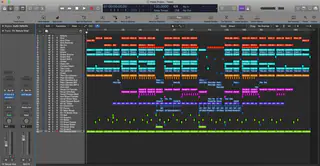
Gabriel Evoke’s (@gabrielevoke) Son Of Mali EP puts his Minimal and Deep Tech instincts into a focused three-track package for Zero Gravity Music. As the founder of Namata Records and a key name in Brazil’s house circuit, he has built a catalog that already speaks to DJs who care about groove, rhythm detail, and low-end control. This EP continues that path with sharp percussion, acid touches, and synth work that feels direct without losing personality. The title track centers on organic percussion, a hypnotic atmosphere, and a bassline built for long stretches of movement. “Party Time,” his collaboration with Jorge Mattos, brings in a more vocal-led house energy, while “Mind Games” leans toward a deeper acid direction with subtle layers that keep building across the arrangement. Each track has a clear role, and the EP feels like a proper extension of the sound Gabriel has been refining across his releases on AVOTRE, Purveyor Underground, Muzenga, and beyond. For this How It Was Made feature, Gabriel breaks down the tools behind Son Of Mali, including U-He Repro-5, Audiorealism ABL3, FabFilter Timeless 2, UAD Studer A800, and TAL-Filter-2. The throughline is motion. Each plugin plays a role in shaping groove, space, modulation, and tone while keeping the arrangement clean enough for the rhythm to stay in control. U-He Repro-5 The highlight is the U-He Repro 5, a synthesizer that emulates the classic Prophet-5. It has a warm, rich, analog texture with that “vintage soul.” I use it a lot to create leads, bass, and pads. Like all U-He plugins, it’s of excellent quality. In this case, I worked with a preset in the Leads bank called Az Filthy Groove, creating a 5-voice polyphonic timbre. I was looking for a synth with a more aggressive tone, not too closed off, so that it would stand out in the mix but also not steal the show. So, in the oscillator, I chose a “sawtooth” waveform and pushed it up an octave. I worked with the filter, opened the cutoff, made slight adjustments to the decay and sustain, and left the release a little more open, bringing a slight expansion to the sound. To polish the timbre, I used the Lexicon Room reverb, my favorite for synths. One cool detail was using the TAL-Filter-2 with the LP Slow Sine preset, adding movement to the sound and preventing it from sounding flat and lifeless. I highly recommend this synth for Minimal/Deep Tech producers who like a more old-school sound; the bass, synth, key, and pad banks are great. Although I don’t usually work with the plugin’s FX section, the Repro-5 offers a great selection of distortion, reverb, and delay, which can be very rich when combined. Audiorealism ABL3 I’m passionate about acid tones; that “melted” sound really grabs me. I believe it’s a great ingredient for Minimal/Deep Tech tracks. In Son Of Mali, it plays an important role in building the groove. I usually work with the Audiorelealism abl3 plugin, which meticulously emulates the sound of the legendary Roland TB-303 synthesizer. I like to work in “Classic” mode, creating my tone from scratch. The cutoff, resonance, and env mode parameters are what truly shape the tone. Working with automation, opening and closing these parameters, is a great tip for adding movement to the track, as well as creating a more interesting structure, opening the sound at peak moments or during a build-up, and closing it at the end of a measure. I really enjoy working with the reverb from the Pioneer RMX-1000 plugin to create an atmosphere in the breakdowns. One really interesting way to work with this plugin is to choose the “Random” mode in the “Pattern” section, where the plugin generates different melody ideas for you. First, you define the musical scale you want to work with, and then, using the “Apply” button, you can test different ideas. Often, when I’m “stuck” or lacking creativity, I use this option to get ideas for bass lines. FabFilter Timeless 2 I like to bring movement and spatiality to my Minimal House tracks; I see it as an important characteristic of the genre. A plugin I use a lot for this is FabFilter Timeless 2, a great delay, super complete, with different parameters to work the sound in endless ways. Its preset bank is quite extensive. I really like using it on stabs, vocals, or even percussion. I think it’s really cool to be able to work with the delay specifically and separately for each side of the stereo, L and R. I can choose the signature, feedback, and how the sound behaves in the spectrum in general. Remember that working with parameter automation is an important and functional feature to make your tracks sound more interesting. In Son Of Mali, I used Timeless 2 in an FX to bring movement and continuity to the element. I used the Basic Stereo Delay preset and worked on the parameters until I found the right point. UAD Studer A800 I have a very complete pack of UAD plugins, which are of very high quality. I use them quite a lot in my mixing processes. The UAD Studer A800 is a p
IndustryHouseBreaks
How It Was Made: Gabriel Evoke – Son Of Mali (Minimal / Deep Tech)
·
Summary of the article
Gabriel Evoke’s (@gabrielevoke) Son Of Mali EP puts his Minimal and Deep Tech instincts into a focused three-track package for Zero Gravity Music. As the founder of Namata Records and a key name in Brazil’s house circuit, he has built a catalog that already speaks to DJs who care about groove, rhythm detail, and low-end control.
Read the full article for more details on EDM Dance Directory News.
Share this article:
Gabriel Evoke’s (@gabrielevoke) Son Of Mali EP puts his Minimal and Deep Tech instincts into a focused three-track package for Zero Gravity Music. As the founde...
Written and reviewed by our team. Technology may support research, but final content is human-authored.