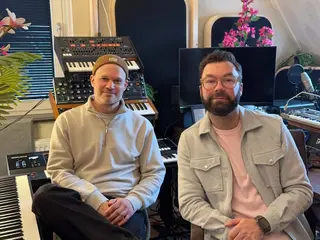
Daniel Leseman and Hans Peeman started making trance in their attic at age 14 in 1999, but it wasn’t until their early 30s that they found their true creative calling with Fouk and their vinyl-first label, Outplay. The Dutch producers have since become beloved in the underground deep house scene, thanks to a sophisticated, distinct blend of loose and dusty house drums, swirling and spacey synth parts, and downright funky basslines. Now both 42 years old, the creative relationship the duo has evolved, and they’re optimistic about Fouk’s future. But they admit that their momentum stalled after the pandemic; their focus shifted to their families and other job prospects, and inspiration was tough to find. Fouk were forced to rediscover their groove. Thanks to their recent EP releases, 2025’s Get It Done and 2024’s Mirage, Daniel and Hans are having just as much fun in the studio as they were almost 30 years ago, with a dynamic that works unusually well. Get It Done EP by Fouk “We always say it’s a second marriage,” says Hans. “Yeah, and we sometimes fight like it’s a second marriage,” adds Daniel, as they both chuckle. More amusing still is that Fouk are constantly finishing each other’s sentences throughout the interview. As Daniel starts articulating an idea, Hans will jump in and finish the thought when Daniel pauses, and vice versa. It’s incredibly fun to observe. However, this marriage-like rapport is a boon when they’re in the studio. These two producers bounce off each other in conversation just as they do with creative ideas. “Sometimes, he’s doing something on the synths,” explains Daniel. “And I’ll say, ‘Okay…What are you doing?’ and he’s like ‘Just wait, just wait. I’m getting it.’” “I don’t give up easily,” chimes in Hans. “And sometimes, it doesn’t work — but I’ll just chuck something in and see if we can shift or transpose it to see if it’ll fit.” Their relationship also makes room for honesty. When an idea isn’t working, they can candidly say to one another, “I’m not feeling this — let’s do something else.” The duo aren’t churning out finished tracks every week, and they’ve learned to work more efficiently since the pandemic. Hans’ home studio. Image: Press “We couldn’t find any inspiration after COVID; our lives changed,” says Hans — he and Daniel are both parents now. “Our time in the studio is limited, so we had to re-find our groove,” he continues. “And with that came a different way of creating. We have one, sometimes two days a week together.” Fouk’s new groove involves Hans creating snippets and ideas, which Daniel often jams over the top of with their go-to synths: the Sequential Prophet-6, Moog Sub Phatty, Korg Minilogue and Roland Jupiter-X and JP-8000. “Once you have a starting point, it’s easy to get enthused”, begins Hans, as Daniel adds, “yeah, we bounce ideas around really quickly.” “Also,” continues Hans, “a lot of times, just before we have to wrap up in the studio, we start something else since we’re already warmed up. Then, something totally new happens in the last half hour. It’s like, you have to quit, but you still get this really amazing idea — they’re the little seeds that you have to cultivate.” Studio Utrecht. Image: Press Watch any of Fouk’s social media videos, and you’ll see how much fun they have jumping around various synths, stitching together layers in a loop. Daniel praises the Prophet-6 for its lack of menu-diving and gorgeous sound, while Hans notes their frequent use of the Minilogue for its versatility across their tracks. Although many of these creative sparks lean on the duo’s arsenal of analogue synths, they admit that much of their signature sound has previously been crafted in the DAW. “A lot of times people ask us, ‘You use a lot of analogue gear, right?’ But no,” says Hans. “Mostly, it was made in the box. But we have our ways for shaping the sound, using harmonic distortion on things—” “And, of course, the use of samples, especially in our earlier productions, helps define the ‘analogue’ vibe,” adds Daniel. Get It Done is largely sample-free, compared to Fouk’s earlier work, aside from a string sample on the track Floating. Fouk’s refined sound relies less on sampling old records and more on meticulous microtiming. “If we have a drum loop going and we [want to] add a bassline, there have been times that we purposely move the bassline in front of the kick. And it just works,” explains Daniel. “The attack of the bassline is also a percussive element of course— “It’s also analysing how these old records sound,” continues Hans. “Because it’s with live musicians; you’re not a robot, and that’s what we want to recreate as well. And, of course, classic hip-hop, the sample-based way of making music, that whole shifted feeling with the eighth notes…We don’t quantise anything. It’s mostly by hand, just shifting little bits. There’s a theory to it; it’s not just random.” Hans’ home studio. Image: Press For their drum sounds, the duo often sample vinyl breaks, us
IndustryHouseTrance
Fouk on 25 years of making music, staying inspired, and the techniques behind their sound
Summary of the article
The Dutch duo on their "second marriage," rediscovering joy after COVID, and why they never hit quantise The post Fouk on 25 years of making music, staying inspired, and the techniques behind their sound appeared first on MusicTech.
Read the full article for more details on EDM Dance Directory News.
Share this article:
The Dutch duo on their "second marriage," rediscovering joy after COVID, and why they never hit quantise The post Fouk on 25 years of making music, staying insp...
Written and reviewed by our team. Technology may support research, but final content is human-authored.