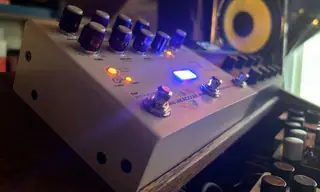
Table of ContentsHologram Electronics MicrocosmSOMA Laboratory WARPHologram Chroma ConsoleUniversal Audio Del-Verb Ambience CompanionEmpress Effects ZOIAMaestro Discoverer Delay Pedal Finding the best hardware effects for synths usually comes down to how well a pedal handles movement, stereo width, transients, modulation, and hands-on control once it leaves a guitar chain and starts working with hardware. Synths already bring plenty of tone on their own, so the right effects pedal should add space, grit, delay, reverb, texture, or rhythmic motion without swallowing the original patch. That is why I tend to gravitate toward pedals that react well to line-level sources, stay playable in real time, and give producers clear ways to shape a sound while the idea is still fresh.The best effects for synths are usually the ones that can take a simple sequence, drone, arpeggio, lead, or pad and give it enough movement to feel finished without needing a huge plugin chain afterward. Some pedals work best as spatial tools, adding delay, reverb, ambience, and stereo depth around a part that already has a clear role in the track. Others work better as sound design boxes, bending a synth line through glitch, tape-style processing, modulation, filtering, looping, or CV control until the original patch becomes something new. I’ve spent a lot of time running synths, drum machines, field recordings, and softsynths through pedals in the studio, and the ones that stay in rotation are the units that offer fast results while still rewarding deeper use over time. This list breaks down the best effects for synths based on actual workflow, sound quality, creative range, and how naturally each pedal fits into a producer’s hardware setup. Hologram Electronics Microcosm The Hologram Electronics Microcosm can turn almost any source sound into an ambient work of art, which makes it an easy pedal to reach for when processing hardware synths outside the box. I had an absolute blast running my Korg MS-20 through it, and the most experimental ideas came when I started feeding it semi-modular patching instead of plain synth lines. The synth’s own movement gave the Microcosm a great source to react to, and the pedal’s modulation pushed those patches into drone territory fast. The looper is a big part of the appeal, since you can record a clean loop, place the effects before or after it, and keep testing new modes until a riff locks in. The Activity knob adds a lot of real-time control, and depending on the mode, it can stretch the delayed grains, smear the audio, or push the modulation into stranger territory. For synth players who want one small box that can turn a simple idea into a full ambient bed, the Microcosm earns its spot quickly. It works best for melodic, ambient, and detail-heavy music where fluid transitions, drones, and textured backdrops are part of the writing. Learn More Here SOMA Laboratory WARP The SOMA Laboratory WARP feels especially good on outboard synths because it gives you direct access to what it does, rather than slowing you down with screens, layers, or menu logic. The whole unit reads like a performance instrument, with input level, output level, mix, algorithm selection, four parameter knobs, and CV inputs all sitting right on the top panel where you can actually grab them. That direct, physical workflow is a big part of why it works so well in hardware rigs, because WARP encourages you to push feedback, sweep filters, move parameters, and force a sound somewhere new in real time. The reverbs are the clearest reason to pay attention to it, especially the Infinity, Generative, and granular options, which can move from sculpted space into self-generating material when pushed near the top of the range. The delay and micro-loop algorithms also suit synth work well, because they move away from straight-delay utility and toward smeared, drifting, layered treatment. CV integration gives it a serious role in modular and hybrid setups too, with dedicated inputs for mix and all four algorithm parameters across a familiar 0 to 5V range. After spending time with it, the WARP feels like a creative hardware tool with personality, manual control, real-time responsiveness, and a sound that never feels generic. Learn More Here Hologram Chroma Console The Hologram Chroma Console is one of those pedals that makes a synth setup feel wider open fast, because its four reconfigurable modules let you stack, reorder, and reshape effects without getting buried in a confusing interface. Character, Movement, Diffusion, and Texture each bring a different lane of sound design, from drive and fuzz to modulation, delay, tape wobble, glitch, filtering, compression, and broken cassette-style artifacts. The stereo effects are a major part of the appeal for synths, since you can run wide delays, modulation, and tone-shaping without fighting mono routing or losing the width of the source. Gesture recording is the feature that really pushes it into cr
IndustryBreaksElectronic
Best Hardware Effects For Synths: Our Favorite Outboard Pedals For Hardware Rigs in 2026
·
Summary of the article
Table of ContentsHologram Electronics MicrocosmSOMA Laboratory WARPHologram Chroma ConsoleUniversal Audio Del-Verb Ambience CompanionEmpress Effects ZOIAMaestro Discoverer Delay Pedal Finding the best hardware effects for synths usually comes down to how well a pedal handles movement, stereo width, transients, modulation, and hands-on control once it leaves a guitar chain and starts working with hardware. Synths already bring plenty of tone on their own, so the right effects pedal should add space, grit, delay, reverb, texture, or rhythmic motion without swallowing the original patch.
Read the full article for more details on EDM Dance Directory News.
Share this article:
Finding the best hardware effects for synths usually comes down to how well a pedal handles movement, stereo width, transients, modulation, and hands-on control...
Written and reviewed by our team. Technology may support research, but final content is human-authored.