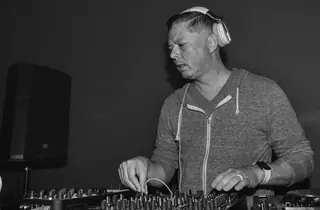
Andrei Morant’s new Grain Damage EP landed on Antimodus, reinforcing the approach that has defined his work for years: precision, pressure, and a clear commitment to techno built on function rather than excess. The four-track release moves through sharp percussion, hypnotic loops, and tightly controlled tension, with Tim Xavier stepping in to remix “Ambrose” and add another angle to the record’s stripped, forward-driving framework. It also marks Morant’s second release on the imprint, adding another chapter to a catalog that already stretches across labels like Illegal Alien Recordings, Planet Rhythm Records, and Dystopian Rhythm. That focus on craft runs straight through this conversation. Morant speaks about success in terms of smaller rooms, strong relationships, and the chance to keep refining his sound rather than chasing scale for its own sake. He also talks about routine, discipline, and respect, which makes sense for an artist whose sets are built largely from his own unreleased material and whose daily process starts before sunrise. Framed against Grain Damage, the interview gives a useful look at how Morant thinks about techno now: as a long practice grounded in experimentation, clarity, and steady commitment to the music itself. Interview With Andrei Morant How do you personally define success in DJing at this stage? At this point in my career, I’d define success as playing smaller, more intimate venues where the music is the focus, not so much the DJ or the booth. Being able to play in cities and countries where I already have great relationships with people is a huge bonus. Seeing friends I’ve made over the 30+ years of DJing is always a wonderful experience. Being able to travel to new places, too, any time I get to experience a new culture is priceless, really. What keeps your attention anchored in the music itself? I think it’s the experimentation. Tinkering in the studio, shaping sounds, sound design, and mixdowns. I’m constantly in awe of the music that’s out there, both new and old. I study the arrangements, textures, effects, synths, and drum sounds. Also, the complexity, and sometimes the simplicity. Other artists push me constantly with their amazing work. When the surrounding noise increases, how do you return to the fundamentals? I usually work first thing in the morning, typically around 5 am. My head is clear, it’s a fresh day, a new palette to work with. No one is texting or emailing at that hour. I’ve been doing this for about the last eight years, and it’s a very productive way for me to create. How do you stay aligned with your priorities as opportunities expand? I feel that expanding opportunities is a product of staying aligned with your priorities. Switching my priorities would sabotage me from getting the opportunities that I have been working towards. My priorities are simple: make and play the best Techno that I can. That won’t change. Have you observed shifts in how artists balance visibility and musicianship? Absolutely. It’s a sign of the times. Thankfully, I came up in a different era, but that’s not to say it was easy back then. In the early to mid-90s, there was almost no visibility for a local aspiring DJ to get out-of-town gigs. Hustling to get music signed to known record labels was just about the only way to do it. These days, for example, I’ve been putting up reels of my production sessions multiple times a week. Mostly for fun, but also to grow an audience. That’s something that’s a real learning process for me. What still excites you about digging, programming, and shaping a set? It’s my first love when it comes to electronic music. I started DJing when I was 15 on some old junk turntables and a cheap mixer. After thousands and thousands of hours, and almost 40 years, it never really gets old. Finding that gem in a sea of new music, B-sides, and loops. Also, getting to play a lot of my own tracks is always a great experience. Most of my sets are about 90 percent my own productions, mostly unreleased tools and tracks that I’ve made specifically to play in my sets. If you could preserve one core value within DJ culture, what would it be? Always respect the DJs playing before you and after you. I have always tried my best to acknowledge my fellow performers. Try not to crowd them or interfere with their setup or their set. If they’re playing after you, make sure to give them space to prepare and give them enough time with your last track so they can mix in properly. The post Andrei Morant on Techno Craft, Discipline, and the Release of Grain Damage appeared first on Magnetic Magazine.
IndustryTechnoElectronic
Andrei Morant on Techno Craft, Discipline, and the Release of Grain Damage
·
Summary of the article
Andrei Morant’s new Grain Damage EP landed on Antimodus, reinforcing the approach that has defined his work for years: precision, pressure, and a clear commitment to techno built on function rather than excess. The four-track release moves through sharp percussion, hypnotic loops, and tightly controlled tension, with Tim Xavier stepping in to remix “Ambrose” and add another angle to the record’s stripped, forward-driving framework.
Read the full article for more details on EDM Dance Directory News.
Share this article:
Andrei Morant’s new Grain Damage EP landed on Antimodus, reinforcing the approach that has defined his work for years: precision, pressure, and a clear commitme...
Written and reviewed by our team. Technology may support research, but final content is human-authored.