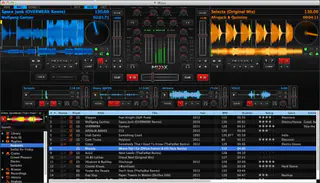
When we first learned about Mixxx, it almost seemed too good to be true. Built entirely as a free, open-source platform, Mixxx has quietly grown into one of the most capable and flexible DJ applications available today. It’s powerful enough for club performance, yet accessible to anyone with a laptop and a love of mixing. Oh, and because it’s open-source, it’s entirely customizable. There’s no way a piece of software like this should even work – but it does. Developed by a global community of volunteers, Mixxx is shaped as much by the DJs who use it as by the developers who write its code. From deep controller scripting and timecode vinyl support to broadcast-ready streaming tools and a modular effects engine, the software reflects a philosophy rooted in transparency, experimentation, and shared ownership. Rather than chasing lock-in or exclusivity, Mixxx embraces adaptability – running across Windows, macOS, Linux, and beyond, and supporting an ever-expanding range of hardware. We had the chance to catch up with Owen the Mixxx development team to figure out just how this too-good-to-be-true platform got its start and continues to evolve every single day. Read on to learn more about why Mixxx just had to exist, and how its dedicated community continues to shapes it every single day. We guarantee that by the end, you’ll want to give it a try. What originally motivated the creation of Mixxx as an open-source alternative in the DJ software space? The Mixxx DJ Software project goes back a long way to 2002, when it was originally created as part of a PhD thesis by Tue Haste Andersen as a way to research new interfaces for DJing, and he soon released it as Open Source. So from the beginning, Mixxx has been a tool for learning about software development and design as much as DJing and making music. It has had several waves of development teams over the years as contributors move on and new ones step up. Some contributors are students looking to learn how to code at an advanced level, others are established engineers interested in the technical problems of a realtime audio mixing system. Everyone who has worked on Mixxx is motivated to make the software better and also to give back to the open source community. Mixxx also has a goal to make DJing available to everybody regardless of means, and staying open source allows us to stay true to that mission. In your view, what advantages does open-source development provide that proprietary DJ platforms simply can’t match? Mixxx has a many advantages, the first of which is flexibility and openness. Mixxx works on three major operating systems, dozens and dozens of controllers, can play just about every audio file type including some very obscure ones, and works with countless audio hardware cards. And that’s just what Mixxx can do out of the box. Mixxx’s controller mappings are written in Javascript and XML, so it’s possible to imagine entirely new ways of controlling music playback. Also, Mixxx works on much older hardware than most manufacturers target. We have users from around the world who do not have access to the latest PCs and operating systems, and we think they should be able to throw parties too. Mixxx also has a lot of users in the streaming radio space, allowing anyone from a hobbyist, to a local church, to an underfunded nonprofit to stream music and audio over the internet. This is an underappreciated use for a project that advertises itself as a nightclub-style party-making application. How does the developer community contribute to shaping Mixxx’s feature set and priorities? Every part of Mixxx exists because someone wanted or needed it to be there. Priorities are set by the developers who work on Mixxx, and that goes for first-time contributors as well as veteran maintainers. Mixxx has no formal development organization other than a small group of Core Maintainers who help guide development. That doesn’t mean Mixxx will include in just any contribution. Our number one rule is “Don’t Stop The Party”. Stability is our highest goal, and we will not include features that run the risk of causing crashes or glitches. So our bar for contributions is very high. A new feature has to be well written, bug-free, and well-documented for our users. As a core team we wrestle with ideas and use a consensus process to make decisions. Our goal is to create a welcoming culture of respect and tolerance and to be a project that people enjoy contributing to, even when we disagree. What kinds of experimental features have become possible specifically because Mixxx is open source? One of our users hacked into the guts of Mixxx and extracted a clock signal to synchronize Mixxx with their module synthesizer setup, and have even created a hardware module to do this for others: https://www.youtube.com/watch?v=hSNHhLqYp_o. We’ve wanted to add a clock feature for a while, but nobody has been able to step up to do it officially, and this user was able to look at the code and do it th
Industry
A Look Into the Only Open-Source DJ Software On the Market: A Conversation with the Mixxx Team
Summary of the article
When we first learned about Mixxx, it almost seemed too good to be true. Built entirely as a free, open-source platform, Mixxx has quietly grown into one of the most capable and flexible DJ applications available today.
Read the full article for more details on EDM Dance Directory News.
Share this article:
When we first learned about Mixxx, it almost seemed too good to be true. Built entirely as a free, open-source platform, Mixxx has quietly grown into one of the...
Written and reviewed by our team. Technology may support research, but final content is human-authored.